
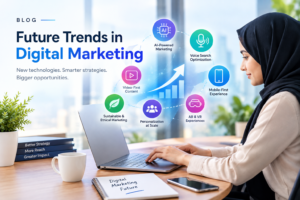
Future Trends in Digital Marketing
The digital marketing landscape is constantly evolving, and businesses must keep up with the latest digital marketing trends to remain competitive. Staying ahead of these digital marketing trends is no longer optional — it has become essential for brands that want to maintain visibility, build trust, and connect meaningfully with their audiences in an increasingly crowded online space.
Artificial intelligence (AI) and machine learning are among the most important digital marketing trends shaping this evolution, offering innovative ways to analyze data, predict customer behavior, and personalize marketing campaigns. These technologies enable businesses to automate repetitive tasks, such as email responses and ad targeting, freeing up time for more strategic efforts. AI-powered tools can now generate content ideas, optimize ad spend in real time, and even anticipate which products a customer is likely to purchase next, giving marketers a level of precision that was previously impossible.
Another significant trend among current digital marketing trends is the growth of voice search and smart devices. With the increasing popularity of voice-activated technologies like smart speakers and virtual assistants, businesses need to optimize their content to meet the demands of voice queries. This involves prioritizing conversational keywords and ensuring websites are mobile-friendly and fast-loading to improve accessibility for users on the go. Voice search queries tend to be longer and more natural in phrasing compared to typed searches, which means brands must shift their SEO strategies toward answering direct questions and focusing more heavily on local search, since a large share of voice queries are location-based.
Video content continues to dominate as one of the most influential digital marketing trends, making it crucial for businesses to invest in short-form videos, live streams, and interactive media. Platforms like TikTok, YouTube, and Instagram Reels are prime spaces for brands to creatively showcase products and engage with audiences in real time. Short-form video in particular has proven highly effective at capturing attention quickly, and brands that consistently produce authentic, relatable content tend to see stronger engagement than those relying solely on polished, traditional advertising formats.
Augmented reality (AR) and virtual reality (VR) are also gaining momentum as emerging digital marketing trends worth watching. These immersive technologies allow customers to experience products and services in a more engaging way, such as virtual try-ons for retail items or interactive 3D product tours. Businesses leveraging AR and VR can create memorable experiences that differentiate them from competitors. As the required hardware becomes more accessible and affordable, industries ranging from real estate to fashion to education are expected to adopt these tools to offer richer, more interactive customer experiences.
Privacy and data security are increasingly important considerations as consumers become more aware of how their information is used online. As third-party cookies phase out, businesses will need to prioritize transparent practices and focus on first-party data collection strategies, such as email sign-ups and customer surveys, to maintain trust and comply with changing regulations. Brands that are open about how they collect and use customer data will likely earn greater loyalty than those relying on opaque tracking methods.
By staying adaptable and embracing these digital marketing trends, businesses can capitalize on future opportunities, connect with their audience more effectively, and drive meaningful growth in an ever-changing digital landscape. Those who invest early in AI, voice search optimization, video content, immersive technologies, and privacy-first practices will be best positioned to lead their industries rather than simply react to change as it happens.