
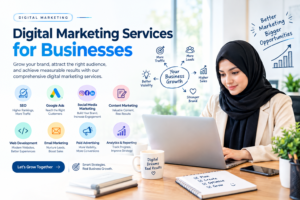
Digital Marketing Services for Businesses
Businesses can use a wide range of digital marketing services to strengthen their online presence, reach potential customers, and achieve sustainable growth. As more consumers search, compare, and purchase products and services online, having a strong digital marketing strategy has become an important part of business development. From improving search engine visibility to building relationships through social media and email, digital marketing allows businesses to connect with their target audience through multiple online channels.
Search Engine Optimization (SEO)
Search engine optimization (SEO) is one of the most important digital marketing services for businesses that want to improve their visibility on search engines. SEO involves optimizing website content, technical elements, keywords, page structure, and other factors to help a website appear more prominently in relevant search results. A well-planned SEO strategy can help businesses attract organic traffic from people who are actively searching for their products or services.
SEO also includes local search optimization, which can be particularly useful for businesses serving a specific geographical area. Optimizing business information, creating relevant local content, and maintaining consistent online information can help businesses improve their visibility among nearby customers.
Search Engine Marketing (SEM)
Search engine marketing (SEM) uses paid advertising to increase a business’s visibility on search engine results pages. Unlike organic SEO, paid search campaigns can provide businesses with opportunities to appear in prominent positions for selected search terms. Businesses can create targeted campaigns based on keywords, location, audience characteristics, and other criteria.
A well-managed SEM campaign can help generate website visits, inquiries, leads, and sales. Continuous monitoring and optimization are important because campaign performance can vary depending on competition, audience behavior, advertising costs, and the quality of the landing page.
Content Marketing
Content marketing is another essential component of digital marketing services. It focuses on creating and distributing useful, relevant, and engaging content for a specific target audience. Content can include blog posts, website pages, articles, videos, infographics, case studies, guides, social media posts, and other digital resources.
High-quality content can help businesses demonstrate their expertise, answer customer questions, support SEO efforts, and build trust with potential customers. Instead of focusing only on direct promotion, effective content marketing provides information that helps customers understand their problems and explore possible solutions.
Businesses should develop content around topics that are relevant to their audience and aligned with their business objectives. Using appropriate keywords naturally within useful content can also support search visibility without compromising readability.
Social Media Marketing
Social media marketing helps businesses communicate directly with their audience through platforms such as Instagram, Facebook, LinkedIn, YouTube, and other relevant channels. Social media provides opportunities to share content, introduce products and services, respond to customer questions, showcase company updates, and build an active online community.
An effective social media strategy starts with understanding the target audience and selecting platforms that match their interests and behavior. Businesses can use a combination of educational content, promotional posts, videos, images, customer stories, and interactive content to maintain engagement.
Social media marketing can also support brand awareness by helping businesses maintain a consistent visual identity, tone, and message across different platforms.
Email Marketing
Email marketing remains a useful digital marketing service for businesses that want to communicate directly with existing and potential customers. Businesses can use email campaigns to share newsletters, product updates, offers, educational content, announcements, and personalized recommendations.
Email automation allows businesses to send relevant messages based on customer actions or specific stages of the customer journey. For example, automated emails can be used for welcome messages, follow-ups, abandoned-cart reminders, or customer updates.
Segmenting an email audience can make campaigns more relevant because different groups of customers may have different interests and needs. Tracking metrics such as open rates, click-through rates, and conversions can help businesses understand campaign performance.
Pay-Per-Click Advertising
Pay-per-click (PPC) advertising provides businesses with a way to promote their products or services through paid online advertising. With PPC campaigns, businesses generally pay when users interact with an advertisement, such as by clicking it.
PPC advertising can be used across search engines, social media platforms, and other digital advertising networks. Campaigns can be targeted using factors such as keywords, location, demographics, interests, and online behavior.
One of the major advantages of PPC advertising is the ability to monitor campaign performance and adjust budgets based on results. Businesses can test different advertisements, audiences, keywords, and landing pages to identify opportunities for improvement.
Web Development and Landing Page Optimization
A professional website is an important foundation for many digital marketing strategies. Web development services can help businesses create websites that are visually appealing, easy to navigate, mobile-friendly, secure, and optimized for performance.
Landing pages are particularly important for paid advertising campaigns because they provide visitors with a focused destination after they click an advertisement. A clear headline, relevant information, strong call to action, easy navigation, and fast loading experience can contribute to a better user experience.
A website should also clearly communicate the business’s products, services, benefits, contact information, and other important details. Regular updates can help keep the website useful and relevant to visitors.
Analytics and Reporting
Analytics and reporting help businesses understand how their digital marketing activities are performing. Instead of relying only on assumptions, businesses can use data to identify traffic sources, user behavior, campaign engagement, conversions, and other performance indicators.
Analytics can reveal which marketing channels are generating visitors and which campaigns are contributing to business goals. These insights can then be used to improve content, advertising strategies, website experiences, and audience targeting.
Regular reporting also helps businesses track progress over time. Important metrics may include website traffic, leads, conversion rates, engagement, advertising performance, and return on marketing investment, depending on the objectives of the campaign.
Building an Integrated Digital Marketing Strategy
The different digital marketing services work best when they are considered as connected parts of an overall strategy. SEO can help attract organic search traffic, while PPC can provide paid visibility. Content marketing can support both SEO and social media, while email marketing can help nurture relationships with existing leads and customers.
For example, a business could publish an informative blog article optimized for search engines, promote that article through social media, use paid advertising to reach a wider audience, and collect email subscribers through a relevant website offer. Analytics can then be used to evaluate the performance of each activity.
This integrated approach allows businesses to maintain consistent messaging across different online channels while adapting their strategies based on audience behavior and measurable results.
Choosing the Right Digital Marketing Services
Every business has different goals, audiences, budgets, and challenges. Therefore, there is no single digital marketing strategy that works in exactly the same way for every organization. Some businesses may prioritize SEO and content marketing, while others may focus more heavily on social media, PPC advertising, email marketing, or local search.
Before investing in digital marketing services, businesses should identify their objectives and target audience. They should also determine which channels are most relevant to their customers and establish measurable goals for their campaigns.
Digital marketing is an ongoing process rather than a one-time activity. Search trends, customer behavior, platforms, competition, and technology continue to change. Businesses can improve their results by regularly reviewing performance, testing new approaches, updating their content, and adapting their strategies.
Overall, digital marketing services combine technology, creativity, content, advertising, and data to help businesses build a stronger online presence. By selecting appropriate services and connecting them through a well-planned strategy, businesses can reach relevant audiences, strengthen brand visibility, generate leads, and create meaningful customer relationships in today’s competitive digital environment.