
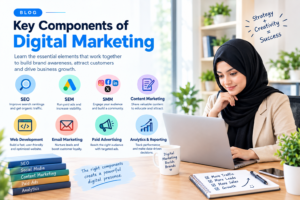
Key Components of Digital Marketing
A digital marketing strategy consists of various interconnected elements that work together to help businesses achieve their goals.
A well-planned digital marketing strategy combines SEO, SEM, content marketing, social media marketing, email marketing, PPC advertising, analytics, and automation to reach the right audience and improve online growth.
Content marketing is another vital component, as it focuses on producing high-quality, relevant content that captures the attention of audiences and builds trust over time. This can include blogs, videos, infographics, and more, all designed to engage users and keep them coming back for more. Social media marketing allows businesses to directly connect with their audience on platforms such as Facebook, Instagram, and LinkedIn. These platforms provide an opportunity for meaningful interactions, audience growth, and increased brand loyalty.
Email marketing is an equally powerful tool that enables businesses to deliver personalized messages straight to their audience’s inbox. With automation, email campaigns can be tailored to specific segments of a customer base, boosting engagement and conversions. Additionally, pay-per-click (PPC) advertising offers a cost-effective way to generate leads and target specific customer demographics through platforms like Google Ads and social media ads.
Beyond these foundational pillars, several other elements play an increasingly important role in shaping a comprehensive digital marketing strategy. Analytics and data-driven decision-making sit at the core of modern marketing efforts. Tools like Google Analytics, heatmaps, and customer relationship management (CRM) dashboards allow businesses to track user behavior, measure campaign performance, and understand which channels deliver the best return on investment. Rather than relying on guesswork, marketers can use this data to refine targeting, adjust messaging, and allocate budgets more efficiently. Without robust analytics, even the most creative campaigns risk missing their mark, since there’s no reliable way to know what’s actually resonating with an audience.
Influencer marketing has also emerged as a significant force, particularly among younger demographics who often trust recommendations from familiar online personalities more than traditional advertisements. By partnering with influencers whose followers align with a brand’s target market, businesses can tap into pre-built communities and generate authentic engagement. This approach works especially well when paired with content marketing, since influencers often create the very blogs, videos, or social posts that carry a brand’s message to a wider audience.
Mobile marketing deserves particular attention given how much time consumers now spend on smartphones. This includes optimizing websites for mobile devices, developing dedicated apps, and utilizing SMS or push notification campaigns to reach customers directly. As mobile commerce continues to grow, businesses that fail to prioritize a seamless mobile experience risk losing customers to competitors who do.
Marketing automation ties many of these components together by streamlining repetitive tasks such as scheduling social media posts, triggering email sequences based on user actions, and nurturing leads through predefined workflows. Automation not only saves time but also ensures consistency, allowing businesses to maintain a steady presence across multiple channels without requiring constant manual oversight. When combined with personalization, automation becomes even more powerful, enabling brands to deliver the right message to the right person at the right moment in their customer journey.
Affiliate marketing offers another avenue for growth, where businesses partner with third parties who promote products or services in exchange for a commission on resulting sales. This performance-based model minimizes upfront risk while expanding a brand’s reach through networks of bloggers, content creators, and websites that already have engaged audiences.
Finally, the concept of omnichannel integration ties the entire digital marketing ecosystem together. Rather than treating SEO, SEM, content, social media, email, and PPC as isolated tactics, successful businesses weave them into a unified customer experience. A potential customer might discover a brand through a blog post, engage with it on social media, receive a follow-up email, and ultimately convert through a targeted ad — all while perceiving a consistent brand voice and message throughout.
By combining these components, businesses can create a cohesive digital marketing strategy that resonates with their audience and drives results.